
Search Itasca County Court Records
The main online route for Itasca County court records is Minnesota Court Records Online, usually called MCRO. MCRO covers Minnesota district trial courts, including Itasca County District Court. The system can show case search results, Registers of Actions, public documents that are available online, hearing information, and docketed money judgment details. It is not the official certified court file. Certified copies and certified civil judgment search results come from Itasca County Court Administration.
Case number searches are often stronger than name searches. Itasca County case numbers commonly begin with county prefix 31, followed by a case type such as CR for criminal, CV for civil, CO for conciliation, FA for family, or PR for probate. A name search can miss pending criminal, traffic, or petty misdemeanor cases with no conviction, and it can also return false matches when people share names or dates of birth.
- Start at Minnesota Court Records Online and accept the required terms before searching.
- Choose Case Search for a full case record or Register of Actions. Use the full case number when it is known.
- Use person, business, attorney, citation number, or attorney bar number searches when the case number is not available.
- Open the case result and read the Register of Actions for filings, hearings, orders, judgments, dispositions, and public documents.
- Use Hearing Search or the Itasca daily public calendar when the immediate question is the date, time, room, Zoom setting, or judicial officer for a hearing.
- Contact Itasca County Court Administration for certified copies, courthouse terminal access, or a public record that is not available remotely.
The official county government homepage is a good starting point for local offices. The Itasca County government site points users toward county departments, while the state court portal handles district court case lookup. That split matters because not every county record is a court record.
The county homepage image from the manifest is sourced from Itasca County's official government homepage.
County pages help confirm local offices and addresses, but court case details still route through the Minnesota Judicial Branch systems and Court Administration.
Itasca County District Court
Itasca County uses Minnesota's unified District Court model. There is no separate county court, justice court, or municipal court for ordinary local trial matters. Civil, family, probate, juvenile, criminal, and traffic cases filed in Itasca County all start in Itasca County District Court unless a federal court or state agency has separate jurisdiction. The local District Court is part of the Ninth Judicial District, which provides district administration for 17 northwest Minnesota counties but does not hear cases itself.
The local courthouse and Court Administration office are in Grand Rapids. Current local District Court judges listed in county materials are Judge Heidi Chandler, Judge Sarah McBroom, and Judge Kimberly Wimmer. Lisa Havluck is the Court Administrator. Court Administration performs the administrative and clerical duties essential to the court and has been a state office since July 1, 2000.
The Minnesota Judicial Branch page for the county is the direct court source. The manifest image below is from the Itasca County District Court page.
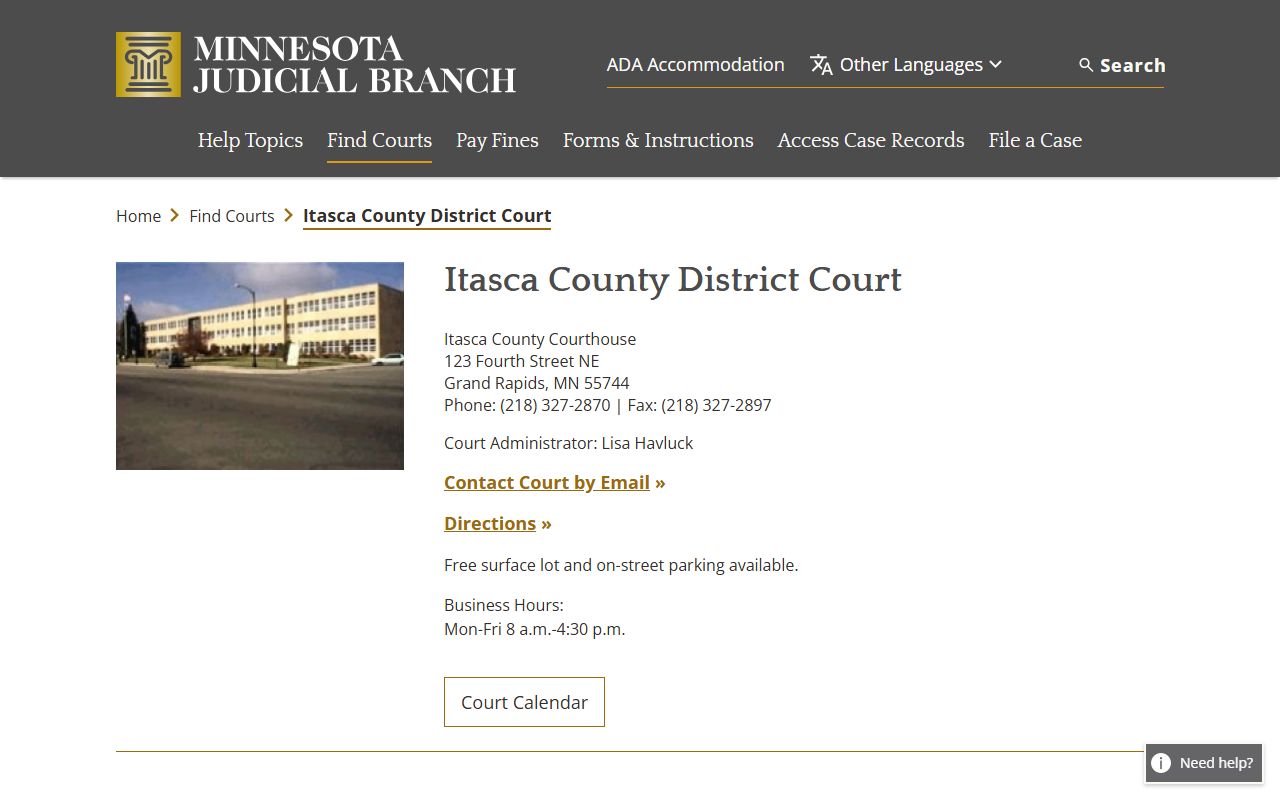
That court page is also where users find links for court calendars, eFiling, jury service, language access, court fees, remote hearings, and court forms.
Itasca County District Court
123 Fourth Street NE
Grand Rapids, MN 55744
(218) 327-2870
Fax: (218) 327-2897
Mon-Fri 8 a.m.-4:30 p.m.; Wednesday counter opens 8:30 a.m.
Court Administrator
Lisa Havluck
Itasca County Courthouse
218-327-2870
Court Administration handles case records and certified court copies.
Itasca County Court Hierarchy
Most local court questions begin and end with District Court. Appeals from District Court go to the Minnesota Court of Appeals, with the Minnesota Supreme Court as the state court of last resort. Federal civil and criminal cases are separate from Itasca County District Court, and bankruptcy matters are handled by the U.S. Bankruptcy Court for the District of Minnesota.
Case flow: Itasca County District Court > Minnesota Court of Appeals > Minnesota Supreme Court. Federal claims, federal crimes, and bankruptcy cases use separate federal courts.
| Court type | Starts local cases? | Records to expect |
|---|---|---|
| District Court | Yes | Itasca civil, family, probate, juvenile, criminal, traffic, conciliation, and judgment records. |
| Minnesota appellate courts | No | Appeal filings and opinions after a District Court decision is appealed. |
| Federal courts | No for county cases | Federal civil, federal criminal, bankruptcy, and federal appellate records outside the county court file. |
| Court or office | Role | Itasca County record impact |
|---|---|---|
| Itasca County District Court | General jurisdiction trial court | Creates local civil, family, probate, juvenile, criminal, and traffic court records. |
| Ninth Judicial District Administration | Regional administration | Oversees district court operations in 17 northwest Minnesota counties, but does not hear cases. |
| Minnesota Court of Appeals | Intermediate appellate court | Reviews District Court decisions when an appeal is filed. |
| Minnesota Supreme Court | State court of last resort | Provides final state-law review in selected cases. |
| U.S. District Court for the District of Minnesota | Federal trial court | Handles federal matters, not county district court case files. |
Itasca County Court Record Types
Court record type depends on the case filed. Civil records can include complaints, petitions, answers, motions, orders, judgments, satisfactions, and appeal filings. Criminal court records can include a complaint, charge counts, hearings, pleas, dispositions, sentences, probation terms, warrants or summons events, and expungement orders. Family matters include dissolution of marriage, custody, child support, paternity, parenting time, and post-decree motions.
Probate records are handled by the Probate Division of District Court and may include wills, informal probate applications, formal petitions, personal representative appointments, notices, inventories, accounts, and closing statements. Traffic records are court records when a citation becomes a payable citation or court case. Juvenile, civil commitment, domestic abuse, and harassment records have stronger privacy limits than ordinary civil or criminal files.
| Record type | Where it lives | Common search route |
|---|---|---|
| Civil and conciliation | Itasca County District Court | MCRO Case Search or courthouse public terminal. |
| Criminal and court charges | Itasca County District Court, with separate BCA criminal-history data | MCRO by case number, and BCA CHS for public conviction history. |
| Traffic and payable citations | District Court and Minnesota Court Web Payment | Citation or case number search for payments, MCRO for court case events. |
| Marriage records | Itasca County Recorder / Vital Records | Minnesota Official Marriage System and Recorder certified copy request. |
| Probate | Probate Division of District Court | MCRO case search using PR case numbers or Court Administration. |
| Jail custody | Itasca County Sheriff's Office and Jail | Sheriff inmate roster and app, not MCRO. |
Itasca County MCRO Fields
MCRO includes several search paths, and each one answers a different question. Case Search is best for the main case record. Document Search is tied to public documents by case number. Hearing Search is used for scheduled events. Judgment Search is limited to docketed money judgments and debtor information. Itasca County users should keep the courthouse counter in mind because public records available on courthouse terminals or at the State Law Library may not all be available on the internet.
The statewide overview image is sourced from the Minnesota Judicial Branch MCRO access page.
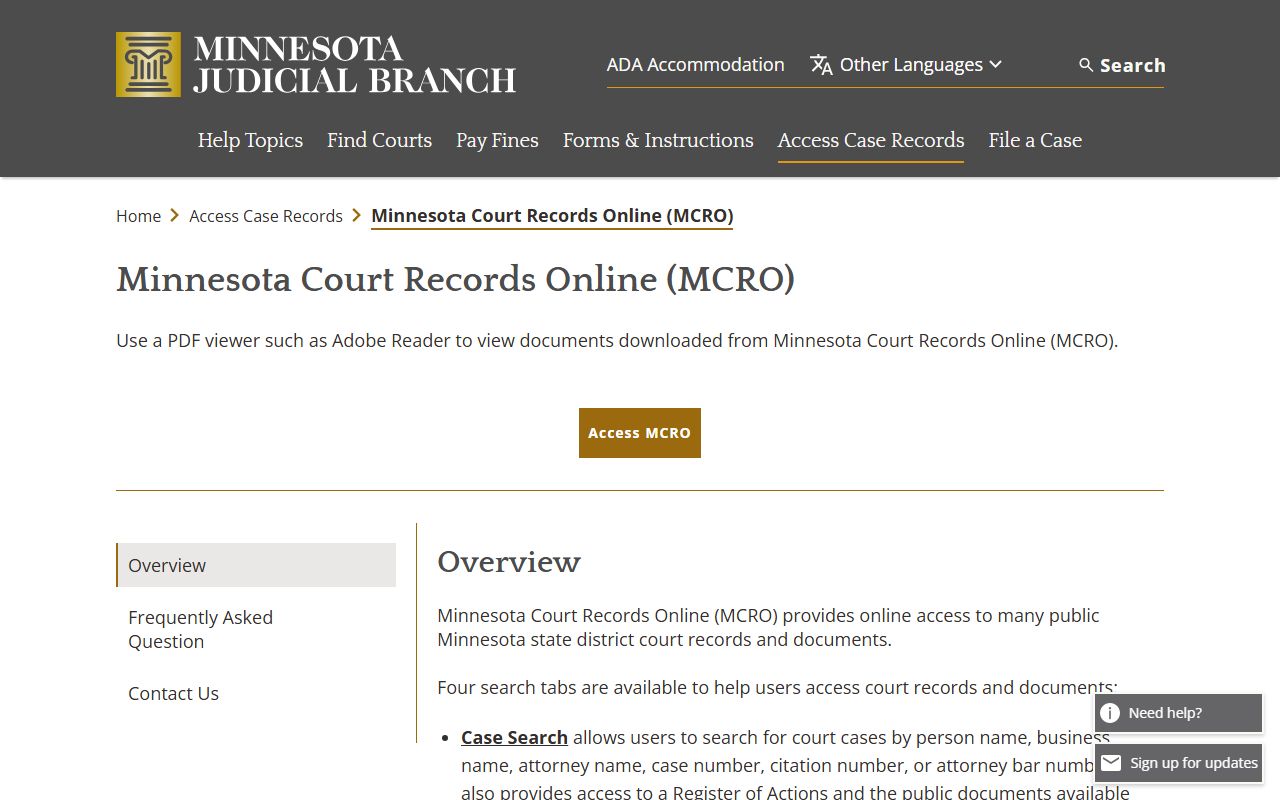
The overview is useful because it separates Case Search, Document Search, Hearing Search, and Judgment Search before a user chooses a specific search path.
The manifest includes a direct image of the case search screen from MCRO Case Search.
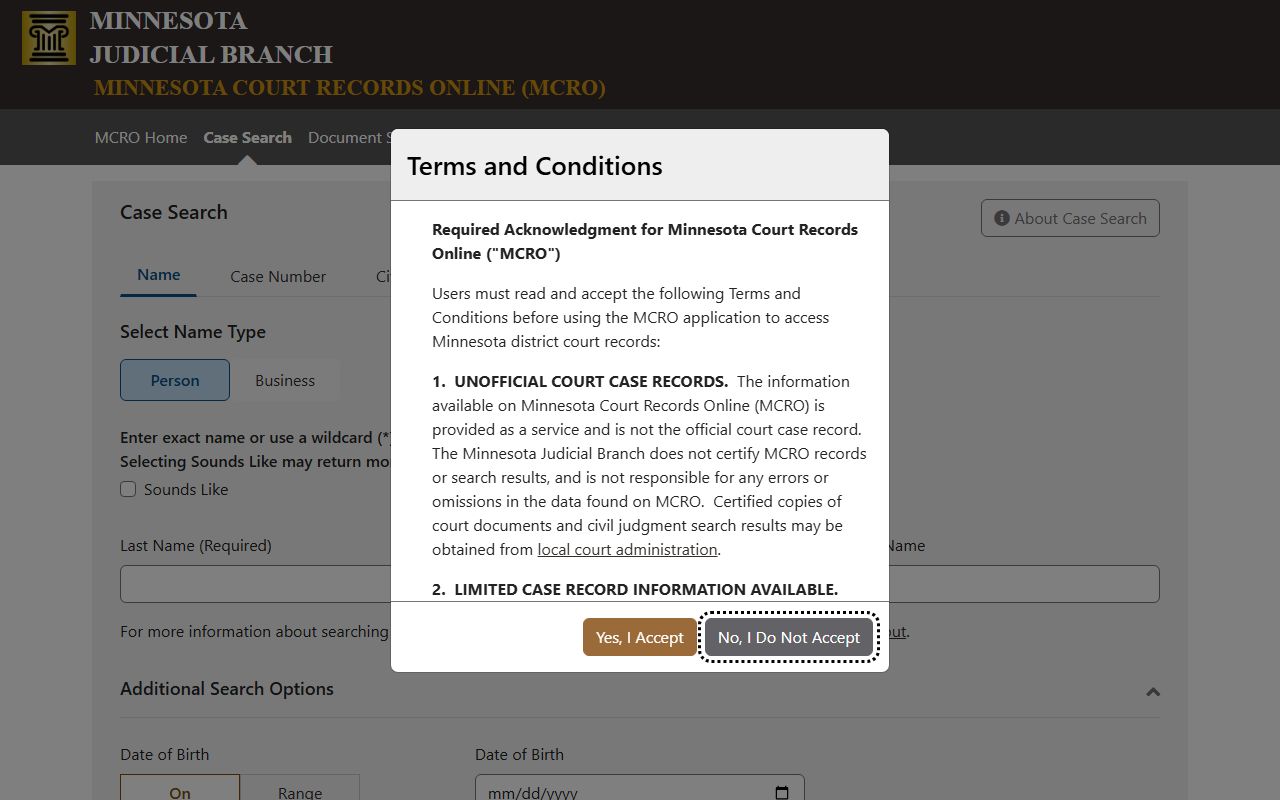
That case search route is useful for public Registers of Actions, but it should not be treated as a certified copy or a complete background check.
| Field label or tab | Type | Required | Format notes |
|---|---|---|---|
| Terms and Conditions | Checkbox or button flow | Yes | The user must accept MCRO terms before viewing records. |
| Name | Search mode | No | Person or business names may return false matches and can miss some pending nonconviction cases. |
| Case Number | Text search | No | Use full numbers such as 31-CR, 31-CV, 31-CO, 31-FA, or 31-PR when known. |
| Citation Number | Text search | No | Used for traffic and citation-related criminal cases. |
| Attorney Name | Text search | No | Supported in case and hearing searches. |
| Attorney Bar Number | Text search | No | Useful when an attorney registration number is known. |
| Judicial Officer | Hearing search field | No | Used to locate hearing information tied to a judge. |
| Debtor Name | Judgment search field | Yes for judgment route | Searches docketed money judgment details. |
Itasca County Court Record Details
A court record is more than a name and case number. The case number identifies the county, case type, year, and sequence. Party names show the role used by the case type, such as plaintiff, defendant, petitioner, respondent, debtor, creditor, or decedent. The Register of Actions is the chronological event list, so it is often the best place to see what has happened without opening every document.
Itasca daily calendar records also show practical hearing fields. Public calendar entries can list party name, hearing location, hearing date, time, judicial officer, hearing type, connection type, and case number. Examples in the research included arraignment, plea, pre-trial, probation violation, conciliation, implied consent, harassment, probate, motion, extradition, and preliminary or probable cause hearings.
| Field | What it shows |
|---|---|
| Case number | County prefix, case category, filing year, and sequence, such as an Itasca 31-CR or 31-PR number. |
| Parties | Names and roles such as defendant, plaintiff, petitioner, respondent, debtor, creditor, or decedent. |
| Judicial officer | The judge or referee tied to a hearing or case event. |
| Hearing data | Date, time, room, Zoom setting, hearing type, and party role when displayed. |
| Charges or cause | Offense statute and severity in criminal and traffic cases, or case cause in civil, family, and probate files. |
| Disposition or judgment | The outcome of a charge, claim, case, or money judgment when entered. |
| Financial fields | Fine, fee, surcharge, restitution, judgment amount, payment status, satisfaction, or bond when visible. |
| Documents | Public documents available online under access rules, with more public material sometimes available at courthouse terminals. |
Itasca County Court Calendar
The Itasca County District Court daily public calendar is a separate access channel for hearing information. It is a searchable PDF posted at 7:00 a.m. each business day and updated hourly. The court page warns that online calendars do not include all matters handled by the court each day. Confidential cases and matters that are not remotely accessible under Minnesota Rule of Public Access 8, subdivision 2, are not posted.
A missing calendar entry should not be read as proof that a hearing was cancelled or moved. Printed courthouse calendars outside courtrooms or in public lobbies contain the most current daily calendar information when changes occur. The calendar also helps explain local docket terms because it shows hearing types and room labels that appear in real Itasca County scheduling.
Note: Always confirm hearing changes with Itasca County Court Administration if a party received a notice or court order.
Itasca County Public Access Rules
Itasca County court records are public when Minnesota court rules make them public, but remote access is narrower than courthouse access. MCRO is free and useful, yet it is not certified by the Minnesota Judicial Branch. It also withholds categories that are not available online, including certain domestic abuse, harassment, juvenile, civil commitment, party address, and comment information.
The public-access framework combines court rules, state data laws, and case-specific sealing orders. Law-enforcement records, jail data, and sheriff records are separate from court case records. Background-style public conviction checks should use the Minnesota BCA criminal-history system rather than treating MCRO as a background-check tool.
Key Minnesota access rules:
Minn. Stat. § 13.03 says government data are public unless law classifies them otherwise.
Minn. Stat. § 13.87 controls public criminal-history data held by the BCA.
Minn. Stat. ch. 609A governs criminal expungement and sealing from public view.
Minnesota Rule of Public Access 4 lists court case record categories that are not public.
Minn. Stat. § 260B.171 gives juvenile delinquency records special access and retention rules.
Itasca County Restricted Records
Restricted records are common in certain case types. Juvenile protection and many juvenile delinquency records are not remotely accessible through MCRO. Adoption records are restricted. Public documents in civil commitment case types are not available through MCRO. Domestic Abuse Order for Protection and Harassment Restraining Order case types are not displayed online because of federal Violence Against Women Act restrictions noted in MCRO terms.
Sealed and expunged records also have public access limits. In Minnesota, a criminal expungement petition generally proceeds in District Court under chapter 609A unless another statutory route applies. The Itasca fee schedule lists a criminal expungement filing at $320 unless a waiver or statutory exception applies. Expungement does not erase the event; it limits public access where the court order and statute apply.
Itasca County Court Fees
Fee questions are handled through Court Administration for district court records and through the Recorder for marriage and vital record items. The Itasca County District Court fee schedule is the official source for court copy fees, filing fees, expungement, divorce, probate, judgment search, and case-management reports. Checks for court fees are payable to the District Court Administrator.
The manifest image below comes from the Itasca County District Court fee schedule.
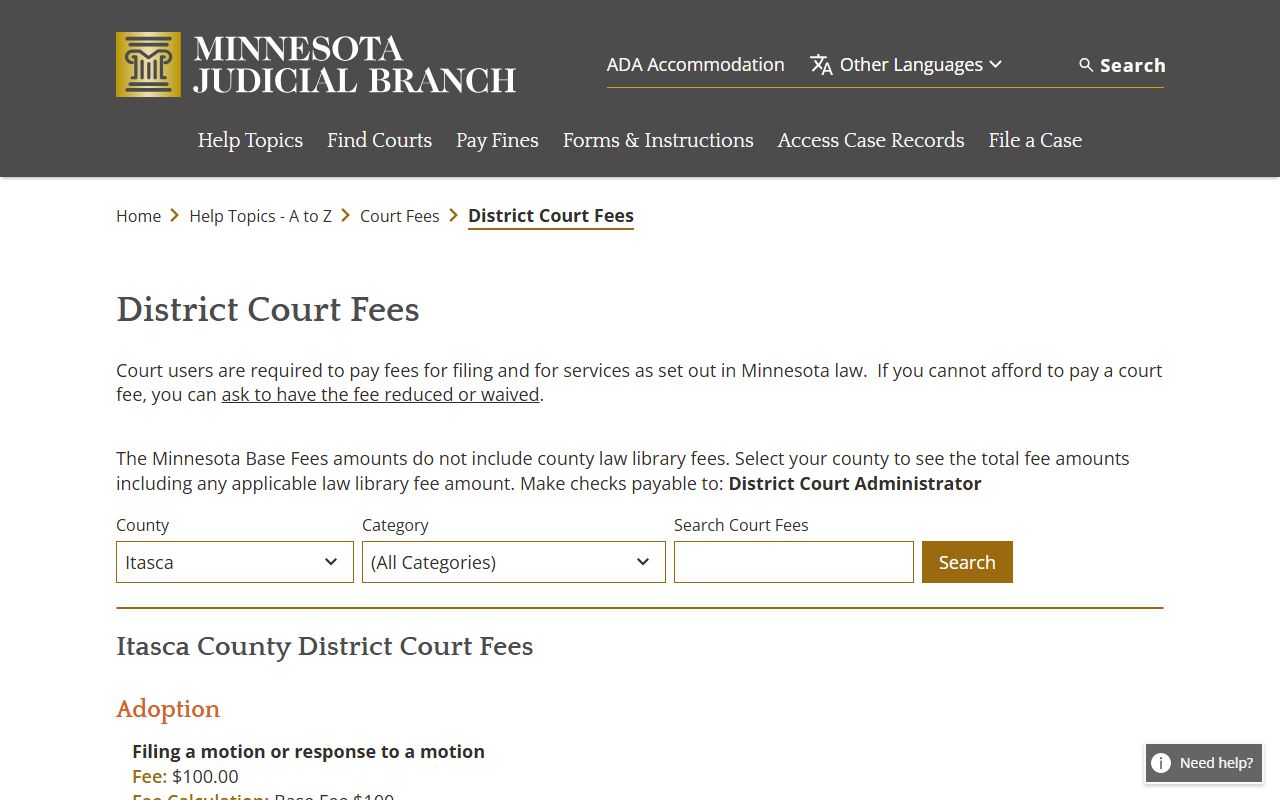
Fees can change, so payment questions should be checked against the current Judicial Branch fee page or with Court Administration before filing.
| Item | Amount | Where handled |
|---|---|---|
| Certified court copy, civil or criminal instrument | $14 | Court Administration |
| Exemplified and certified court copy | $28 | Court Administration |
| Uncertified court copy or courthouse MNCIS printout | $0 | Court Administration |
| Case-management report, 1-50 pages | $5 | Court Administration |
| Case-management report, 50+ pages | $25 per 50 pages or part | Court Administration |
| Criminal expungement filing | $320 | District Court |
| Divorce or dissolution filing | $400 | District Court |
| Probate first paper filed | $320 | Probate Division of District Court |
| Deposit of will for safekeeping | $27 | Probate Division of District Court |
| Certified marriage certificate | $9 | Itasca County Recorder |
Itasca County Court Terms
Short definitions help separate a case record from a jail roster, a charge from a conviction, and a docket from a final judgment. These terms appear often in Itasca County District Court records, MCRO results, and public calendar entries.
- Register of Actions
- The chronological court event list for a case, including filings, notices, hearings, orders, and judgments.
- Docket
- The court's event record for a case, often used when checking what has been filed or scheduled.
- Disposition
- The outcome of a charge, claim, or case, such as dismissed, convicted, adjudicated, or judgment entered.
- Conciliation Court
- Minnesota's small-claims style civil venue within District Court, reflected in Itasca case numbers with CO.
- Expungement
- A court process that seals qualifying records from public view under statute or court order.
- Probate
- The court process for estates, wills, guardianships, and conservatorships in the Probate Division of District Court.
Itasca County Sheriff Records
The Itasca County Sheriff's Office and Jail are separate from Court Administration. The Sheriff's Office is at 108 NE 5th Street in Grand Rapids. The main sheriff number is 218-326-3477, the jail number is 218-327-3477, and the Records Division number is 218-327-7472. Sheriff Joe Dasovich is listed as sheriff, and the jail staff directory names Captain Shawn Racine as Jail Administrator.
The public inmate roster is not the same as a District Court case record. A jail roster can show custody, booking, photo, name, age, booked date, and charge buttons, while MCRO and the court calendar show court hearings and case events. The Itasca County Sheriff MN mobile app is promoted as a mobile access point for inmate roster, data request, Most Wanted, Recent Arrests, and tip features. For custody details, use the sheriff roster or the Itasca County inmate records page.
The manifest image for the court administration section is sourced from the Itasca County Court Administration page, which sits near sheriff and county office information in the local government system.
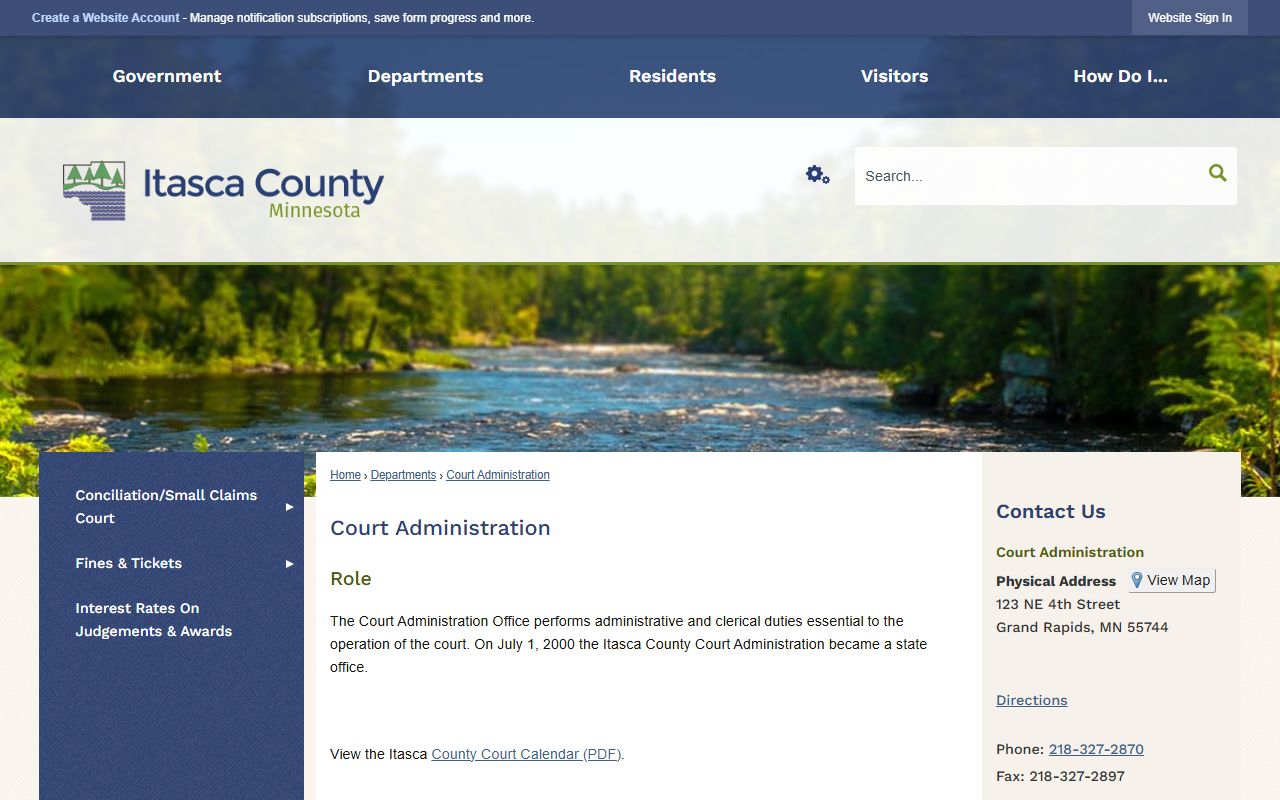
That office separation is important for users moving between a hearing, a jail custody question, and a certified court record request on the same day.
Itasca County Probate and Vital Records
Marriage certificates, marriage licenses, birth and death records, military discharge records, notary commission registrations, and land records are handled by the Itasca County Recorder / Registrar of Titles and Vital Records rather than Court Administration. The Recorder's Office is in the courthouse complex at 123 NE 4th Street in Grand Rapids and lists Nicolle Zuehlke as Recorder / Registrar of Titles and Vital Records. That office is the local route for certified marriage certificates.
Divorce is different. Minnesota calls divorce a dissolution of marriage, and divorce decrees are court records from the District Court that granted the divorce. Probate is also a District Court function. Itasca County probate matters route through the Probate Division of District Court and can involve estates, wills, trusts, guardianships, conservatorships, inventories, final accounts, and closing statements.
Itasca County Record Limits
Online records can lag behind courthouse activity, and remote access does not show every public record. MCRO may omit public records that are available only at courthouse terminals or the State Law Library. The daily calendar is updated hourly after 7:00 a.m. each business day, but printed lobby calendars can be more current. A document that is absent online may still exist in the official court file.
Use the right system for the question. MCRO is the court case route. The BCA Public Criminal History Search is the public conviction-history route. Court Web Payment is the payable citation route. The Sheriff's Office handles jail custody, sheriff records, and data requests. The Recorder handles marriage and vital record copies. Itasca County Court Administration handles certified copies of court documents and questions about the official case file.
Note: Confirm certified-copy needs with Court Administration before relying on a downloaded or printed MCRO document.
Itasca County Court History
Officially verified history for Itasca County court records is strongest on the system side. Court Administration became a state office on July 1, 2000, which reflects Minnesota's statewide administration of local trial court operations. Itasca County remains assigned to the Ninth Judicial District, and all ordinary trial-court case types are handled through District Court rather than separate county or municipal courts.
Record access has also changed. MCRO replaced MPA Remote, and MPA Remote became unavailable on April 17, 2023. The Minnesota Judicial Branch later emphasized MCRO as the online access point for many public district-court documents. A recent local court staffing item also matters: Governor Tim Walz announced Kimberly Wimmer's appointment to a Ninth Judicial District judgeship chambered in Grand Rapids on November 21, 2024.
Itasca County Court FAQ
Can MCRO provide certified Itasca County Court records?
No. MCRO provides public online access, but its records are unofficial and not certified. Certified court copies, certified civil judgment search results, and questions about the official case file go through Itasca County Court Administration at the courthouse.
Why does an Itasca County criminal or traffic case not appear by name?
MCRO warns that pending criminal, traffic, and petty misdemeanor cases with no conviction will not return by defendant-name search. A case-number search may still locate the matter. Name searches can also miss or confuse records because of aliases, similar names, and shared dates of birth.
Where are Itasca County hearings checked?
Use MCRO Hearing Search or the Itasca daily public calendar. The calendar is posted each business day and updated hourly, but it does not show every matter. Court notices and direct confirmation from Court Administration control when there is a conflict.
Are Itasca County jail records court records?
No. Jail custody records are sheriff records. The inmate roster and sheriff app can show booking and custody details, while District Court records show case events, court charges, hearings, pleas, dispositions, and sentencing when public.
Who handles marriage records in Itasca County?
The Itasca County Recorder / Registrar of Titles and Vital Records handles marriage licenses and certified marriage certificates. Divorce decrees are District Court records because dissolution of marriage is filed in court.
Can juvenile or harassment cases be searched online?
Many cannot. Juvenile records have special access rules, and Domestic Abuse/OFP and Harassment Restraining Order case types are not displayed on the internet through MCRO because of access restrictions.